AUSTIN GUIDES / NEW CONSTRUCTION
Pre-drywall inspection near Austin: when to book it, who can do it, what it checks
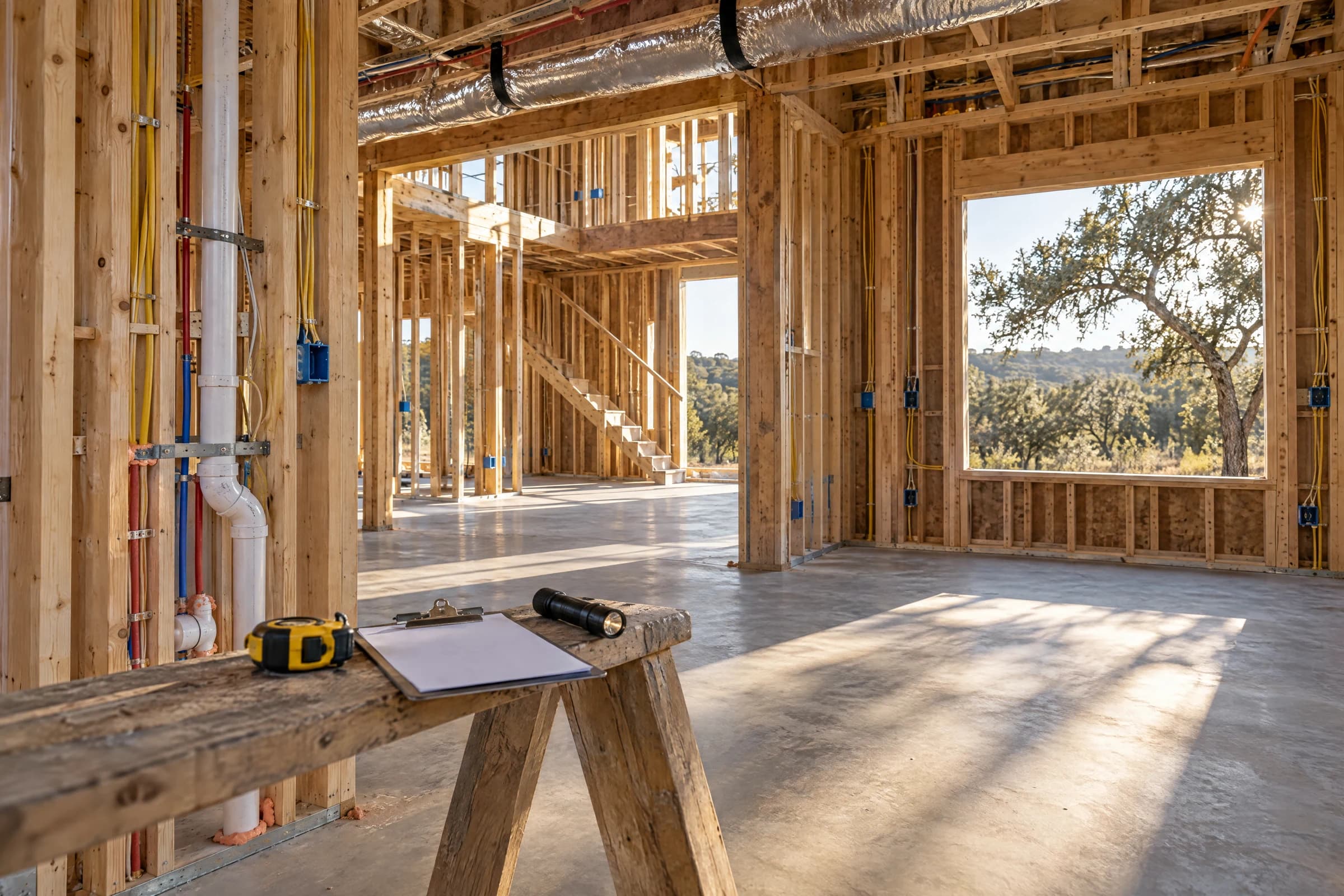
A pre-drywall inspection near Austin is a visit by an inspector you hire after the framing, wiring, plumbing and ductwork are in but before insulation and wallboard cover them. Inside the City of Austin, that window opens when the City's frame group inspection passes and closes at the insulation inspection, according to the City's residential inspection flowchart dated February 1, 2024. In unincorporated Travis County, County Code Chapter 480 already requires the builder to have the framing and mechanical stage inspected before drywall, so ask for that report too.
By David Eimer · Austin Guides · Facts reviewed
The numbers
- City of Austin frame group inspection
- Framing, plumbing top-out and mechanical rough, same dayAs of Flowchart dated 2024-02-01, checked 2026-10-08
Electrical rough must pass, or have minimal violations, first; the insulation inspection is requested only after the frame group is approved.
City of Austin: Residential Inspections Process flowchart (February 1, 2024) ↗
- Builder-arranged inspections required in unincorporated Travis County
- 3: foundation, framing and mechanical, finalAs of Travis County Code Chapter 480, checked 2026-10-08
The framing and mechanical stage is inspected before drywall; reports go to the County within 10 days of the final.
Travis County Code Chapter 480, Residential Construction Standards ↗
- Building code required in unincorporated Williamson County
- NoneAs of Williamson County FAQ, checked 2026-10-08
The County has not adopted Local Government Code Chapter 233, Subchapter F.
- City of Austin wallboard inspection on new construction
- Third party requiredAs of Wallboard checklist dated 2022-08-02
A registered design professional or ICC-certified building inspector; no taping or floating until it is approved.
City of Austin: Building Wallboard Inspection Checklist, Residential (8/2/22) ↗
- City of Austin foundation inspection on a new house
- None by City staff; an engineer's report insteadAs of Foundation checklist dated 2025-07-14
A registered design professional verifies the foundation; the report is uploaded to the permit and provided at the final.
City of Austin: Building Foundation Inspection Checklist, Residential (7/14/25) ↗
- Liability coverage a Texas inspector must carry
- $100,000 per occurrenceAs of Tex. Occ. Code §1102.1141, checked 2026-10-08
Or a bond or other security TREC accepts.
Texas Occupations Code Chapter 1102, Real Estate Inspectors ↗
- Homes TREC's standards of practice cover
- Substantially completed homesAs of 22 TAC §535.227, checked 2026-10-08
A pre-drywall visit comes earlier, so its scope is whatever your written agreement with the inspector says.
22 Tex. Admin. Code §535.227, Standards of Practice: General Provisions ↗
What is a pre-drywall inspection, and when should you book one?
A pre-drywall inspection is a visit by an inspector you hire while the walls of a new house are still open: framing, wiring, pipes and ducts are installed, and insulation and wallboard are not. InterNACHI's pre-drywall standard, updated March 6, 2025, describes it as a non-invasive, visual examination that happens after the foundation, framing and roofing are in and before the insulation and interior walls and ceilings are covered. It is one of the phase inspections a buyer can add to a new build.
The best time to book a pre-drywall inspection in Austin is after every trade has finished its rough-in and the government's framing-stage inspection has passed, but before insulation goes in. Ask the builder's construction manager to tell you, in writing, the day the frame inspection passes and the day insulation is scheduled, and book the inspector between them.
Phase inspections on an Austin-area new build: when each one fits
| Phase | When | Government requirement at this stage | Your own inspector |
|---|---|---|---|
| Pre-pour (foundation) | Forms, steel and under-slab plumbing set; before concrete | City of Austin: plumbing pre-pour and electrical slab inspections, but no City foundation inspection; a Texas-licensed engineer's sealed assessment instead. Unincorporated Travis County: foundation-stage inspection before concrete | Optional visit; ask the builder for the engineer's report |
| Pre-drywall (rough-in) | Trade rough-ins complete; before insulation and wallboard | City of Austin: electrical rough, then the frame group (framing, plumbing top-out, mechanical rough). Unincorporated Travis County: framing and mechanical systems stage before drywall | The visit this guide covers; the last look at framing, wiring, pipes and ducts |
| Final (pre-closing) | House finished; before closing | City of Austin: final group inspections, with duct leakage, envelope leakage, termite, foundation and wallboard reports on site or on the permit | A TREC standards-of-practice inspection of a substantially completed home |
| Before a warranty term ends | Before the builder's workmanship coverage expires (Perry Homes, for example, publishes two years from closing) | None | List items, submit them in writing under the warranty; Property Code Chapter 27 notice if a defect claim follows |
Sources: InterNACHI: Pre-Drywall Inspection Standards of Practice (updated March 6, 2025) ↗ · City of Austin: Residential Inspections Process flowchart (February 1, 2024) ↗ · Travis County Code Chapter 480, Residential Construction Standards ↗
What does a pre-pour inspection check before the slab is poured?
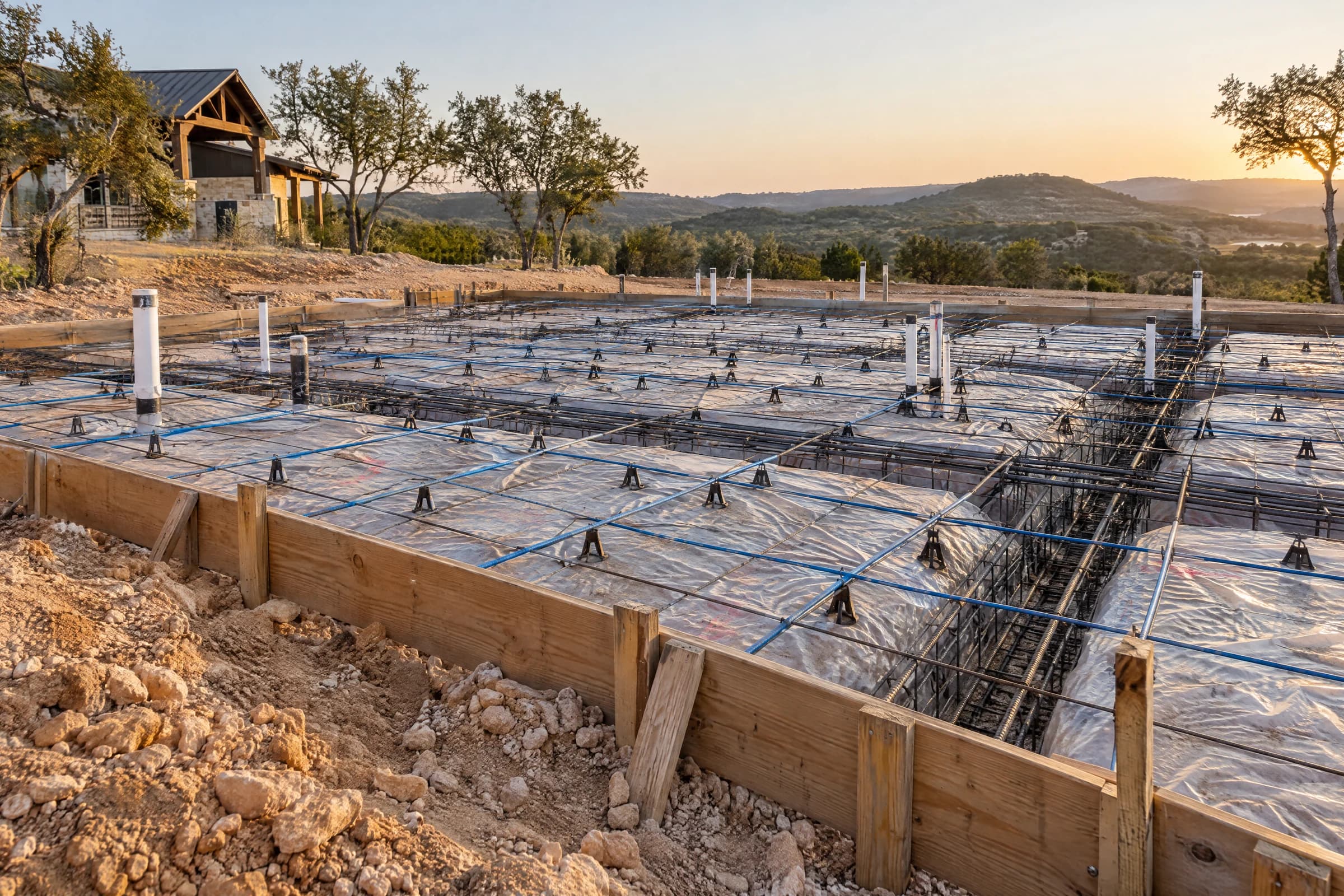
A pre-pour inspection is the first of the phase inspections on a slab-on-grade house: the forms, steel and under-slab plumbing and electrical are in place, and the concrete is not. Once the slab is poured, drain lines and conduit inside it cannot be seen again, so this is the only look at them. In unincorporated Travis County, Chapter 480 makes the foundation stage before concrete one of the builder's three required inspections.
Inside the City of Austin, City inspectors check the layout, under-slab plumbing and the electrical slab work, but not the foundation itself. The City's foundation checklist, dated July 14, 2025, says City inspectors will not perform foundation inspections for new construction; the builder provides a registered design professional's report instead, uploaded to the permit and handed over at the final building inspection. Ask for a copy of that report for your file.
Pre-pour inspection checklist: what has to be right before an Austin slab is poured
| Item | What the City of Austin record says | Checklist (date) |
|---|---|---|
| Layout | Required for all building permits after forms are set; approved plans on site; a new survey by a Texas-licensed surveyor for new construction | Residential inspections flowchart (2/01/2024) |
| Under-slab plumbing | No pipes embedded directly in concrete; sleeves where pipe passes through concrete; drains sloped at least ¼ inch per foot; drain, waste and vent lines tested with a 5-foot water head or 3 psi of air for 15 minutes; pipe laid on a firm bed | Plumbing rough (8/3/22) |
| Electrical in the slab | Raceways approved for concrete encasement; floor boxes within 18 inches of the wall; requested and passed before concrete is placed | Electrical slab (10/25/24) |
| Foundation | No City inspection; a registered design professional's report that required special inspections are complete and the foundation meets the residential code or engineered design | Building foundation (7/14/25) |
| Termite treatment | Typically required at this phase; the certified applicator's documentation is collected at the final building inspection | Residential inspections flowchart (2/01/2024) |
Sources: Travis County Code Chapter 480, Residential Construction Standards ↗ · City of Austin: Building Foundation Inspection Checklist, Residential (7/14/25) ↗ · City of Austin: Residential Inspections Process flowchart (February 1, 2024) ↗ · City of Austin: Plumbing Rough Inspection Checklist, Residential (8/3/22) ↗ · City of Austin: Electrical Slab Inspection Checklist, Residential (10/25/24) ↗
What does the City of Austin inspect before drywall?
Inside the City of Austin, the residential inspection flowchart dated February 1, 2024 sets the order. The electrical rough inspection must pass, or pass with minimal violations, before the frame group is scheduled. The frame group is the framing, plumbing top-out and mechanical rough inspections, scheduled together on the same day for most projects. New construction also needs a third-party pre-frame inspection, and the insulation inspection is requested only after the frame group is approved.
Wallboard is checked by someone other than the City on new construction: the City's wallboard checklist requires a registered design professional or an ICC-certified building inspector, with no taping or floating until it is approved. The foundation is the same. The flowchart says the City does not conduct a physical foundation inspection; a Texas-licensed engineer inspects it and the sealed assessment goes on the permit.
City inspections check code minimums for the permit. They are not an inspection on your behalf, and the City's checklists say they are reference tools, not exhaustive lists. Your pre-drywall inspector works for you and can flag workmanship the code does not address. The Austin permit history post shows how to read a permit's inspection record.
Pre-drywall inspection vs the government's framing inspection
| Question | City or county framing-stage inspection | Your pre-drywall inspection |
|---|---|---|
| Who hires and pays | The City inspects under the builder's permit; in unincorporated Travis and Hays counties the builder hires the inspector | You do |
| Who it works for | The permit process, or the builder who contracted it | You |
| What it measures against | The adopted building code for that stage | The written scope in your agreement with the inspector, plus your contract's plans and specifications |
| Whether it can hold up the next stage | Yes in the City of Austin: insulation is requested only after the frame group is approved | Only through what your contract and the builder agree to |
| Who gets the report | The permit file, or in Travis County the County and the person the home is built for | You, as a written report |
Sources: City of Austin: Residential Inspections Process flowchart (February 1, 2024) ↗ · City of Austin: Building Wallboard Inspection Checklist, Residential (8/2/22) ↗ · City of Austin: Building Framing Inspection Checklist, Residential (8/1/22) ↗
Who inspects new homes outside Austin city limits?
Many new Austin-area communities sit outside any city, and there the rules depend on the county. Texas Local Government Code Chapter 233, Subchapter F lets a county adopt an order requiring new homes in unincorporated areas to meet the International Residential Code and to be inspected at least three times: at the foundation before concrete, at the framing and mechanical stage before drywall, and on completion. The builder hires the inspector, who can be a licensed engineer, registered architect, TREC-licensed professional inspector or ICC-certified residential combination inspector, among others.
Travis County adopted those rules in its County Code Chapter 480, and the builder must file the inspection reports with the County within 10 days of the final inspection. Hays County's Commissioners Court adopted them on September 15, 2009, and its FAQ says the County does not inspect single-family homes itself, so a third party does. Williamson County's FAQ says the County has not adopted Subchapter F and does not require new homes to meet any building code.
Where a city has adopted a building code for its extraterritorial jurisdiction, the city's code controls instead. Ask which entity issued the permit for your lot. The Pflugerville new homes guide lists that City's 20 required residential inspections in order.
Who inspects the framing stage around Austin, by where the lot is
| Where the lot is | Framing-stage inspection | Who performs it | What to ask for |
|---|---|---|---|
| City of Austin building permit | Electrical rough, then the frame group; insulation after; a third-party wallboard inspection for new construction | City inspectors; wallboard by a registered design professional or ICC-certified building inspector | The permit's inspection results and the third-party reports uploaded to it |
| City of Pflugerville building permit | Frame group (framing plus mechanical, electrical and plumbing rough-in), then insulation, wallboard and second-stage poly | City inspectors | The permit's inspection results |
| Unincorporated Travis County | Framing and mechanical systems stage, before drywall (one of three required inspections) | A licensed engineer, registered architect, TREC-licensed professional inspector, municipal plumbing inspector, political subdivision building inspector, or ICC residential combination inspector, hired by the builder | Copies of all three reports, which the builder files with Travis County within 10 days of the final |
| Unincorporated Hays County | The same three stages, under the order the Commissioners Court adopted September 15, 2009 | A third party the builder hires; the County does not inspect single-family homes | Copies of the third-party reports |
| Unincorporated Williamson County | None required: the County has not adopted Subchapter F and requires no building code | Not applicable | Your own inspector's report is the only independent check |
| A city's ETJ where the city has adopted a building code | The city's building code controls instead of the county standard | As that city sets out | Ask the city that issued the permit |
Sources: Texas Local Government Code Chapter 233, Subchapter F (§§233.151-233.157) ↗ · Travis County Code Chapter 480, Residential Construction Standards ↗ · Hays County Development Services: development and floodplain FAQ ↗ · Williamson County: infrastructure and developers FAQ ↗ · City of Pflugerville: Required Residential City Inspections (revised January 9, 2020) ↗
Who can do a pre-drywall inspection in Texas?
Texas licenses home inspectors through the Texas Real Estate Commission under Occupations Code Chapter 1102, which defines a real estate inspection as a written or oral opinion on the condition of a property's improvements, including structural, electrical, mechanical and plumbing items. There are three licenses. On the standard path, a professional inspector must have held a real estate inspector license for at least 12 months and performed at least 175 inspections under indirect supervision; a real estate inspector works under a professional inspector, and an apprentice under direct supervision.
Every licensed inspector must carry liability coverage of at least $100,000 per occurrence, or a bond TREC accepts. Chapter 1102 also bars an inspector from performing or agreeing to perform repairs in connection with an inspection under an earnest money contract, and from acting as the broker in the same transaction. Look up any inspector's license on TREC's license holder search before you book.
TREC's New Home Contract for incomplete construction, form 23-20, says the seller must give the buyer access at reasonable times and that the buyer may have the property inspected by inspectors the buyer selects who are licensed by TREC or otherwise permitted by law. A builder's own contract may say something different, so read its access clause before you sign.
Sources: Texas Occupations Code Chapter 1102, Real Estate Inspectors ↗ · TREC license holder search ↗ · TREC form 23-20, New Home Contract (Incomplete Construction) ↗
What does a pre-drywall inspection check?
No Texas rule sets the scope of a pre-drywall inspection. TREC's standards of practice define the minimum for a real estate inspection of a one-to-four family home that is substantially completed, meaning it can be occupied or used for its intended purpose. A house with open walls is not there yet, so the scope is whatever the written agreement with your inspector says. Get it in writing before the visit.
InterNACHI's pre-drywall standard covers the roof, exterior, foundation and structure, heating and cooling, plumbing, electrical, attic insulation and ventilation, and interior components as they stand at that stage. It also states the limits: the inspection will not identify concealed or latent defects and is not a code-compliance determination.
The City of Austin's own residential checklists are a practical list of what should be right at this stage, with the code section for each item. The table below pulls the items a buyer can see with the walls open. TREC form 23-20 also requires the contract to state the insulation type, thickness and R-value, per Federal Trade Commission rules, so compare what is installed against it.
What to look at before drywall, with the City of Austin checklist item behind it
| Area | What to look for | City of Austin checklist (date) |
|---|---|---|
| Exterior envelope | Flashing at window and door openings; exterior openings and penetrations sealed; steel masonry lintels bearing at least 4 inches; masonry weep holes every 33 inches | Building framing (8/1/22): IRC R703.1, R703.4, R703.8.3, R703.8.6 |
| Plumbing | Drain, waste and vent lines tested with a 5-foot water head or 3 psi of air for 15 minutes; 18-gauge nail plates where pipe is within 1 inch of the framing face; plastic lines supported every 4 feet | Plumbing top-out (8/4/22): BCM 5.6.2.7, UPC 312.9, UPC Table 313.3 |
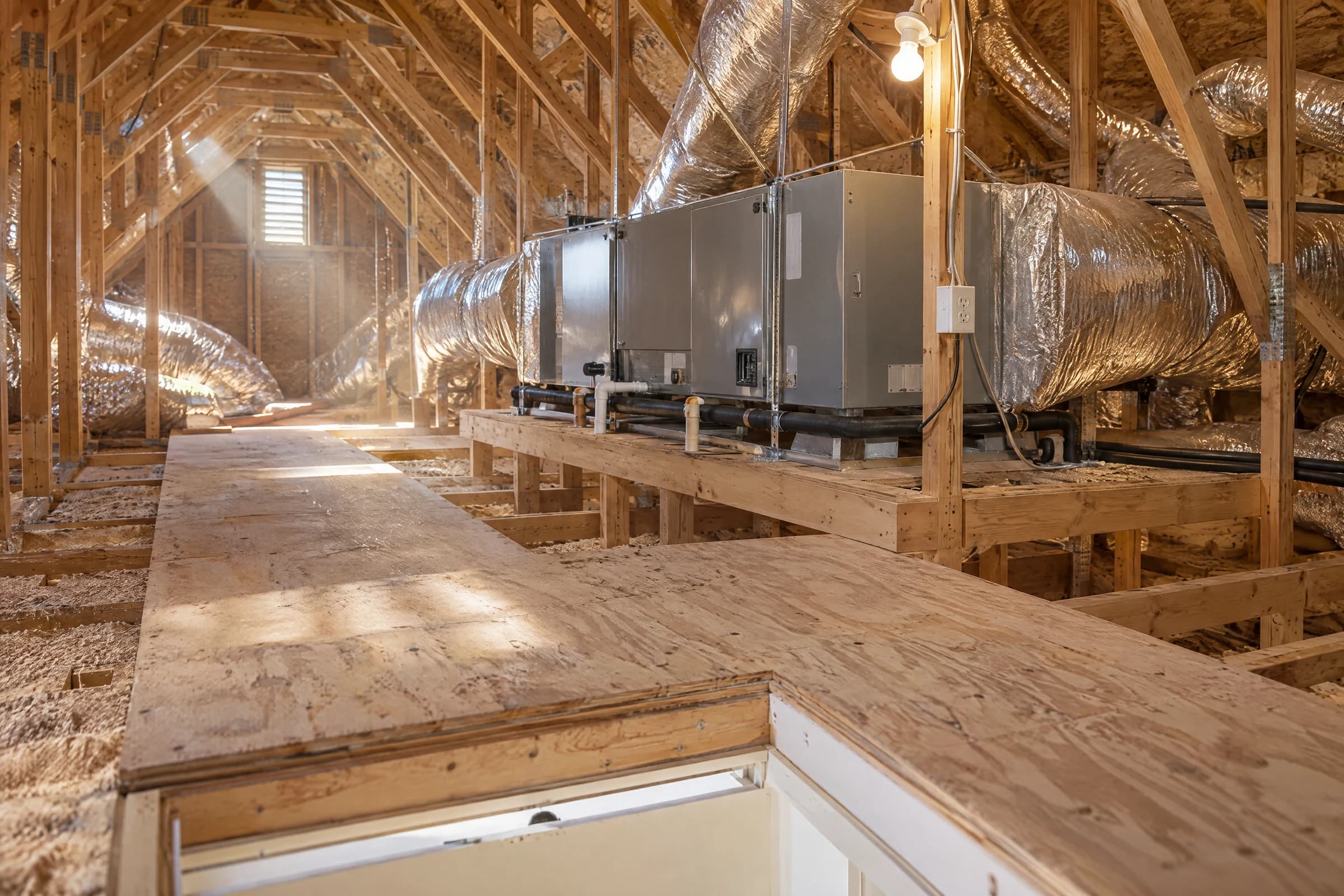
| Mechanical | 16-gauge nail protectors within 1½ inches of a framing edge; a 22-by-30-inch attic access, a 24-inch catwalk to the unit, a 30-by-30-inch work platform, and a light and outlet at the unit | Mechanical rough (8/3/22): IRC M1305, M1308 |
| Electrical | Boxes secured to framing; required receptacles along walls and in hallways 10 feet or longer; switched lighting for rooms, hallways, stairways and attic equipment | Electrical rough (10/25/24): NEC 314.23, 210.52, 210.70 |
| Insulation (next stage) | Batts installed with R-values showing; gaps within the manufacturer's specifications; IC-rated recessed lights; depth markers every 300 square feet for blown-in attic insulation | Building insulation (7/10/25): IECC R303, R402.4.5 |
| Garage separation (at wallboard) | At least ½-inch gypsum board between the garage and the house; ⅝-inch Type X under rooms above a garage | Building wallboard (8/2/22): IRC Table R302.6 |
| Your contract | Installed insulation matches the R-values the contract states; the Construction Documents and any change orders match what is built | TREC form 23-20, paragraphs 7B and 7G |
Sources: 22 Tex. Admin. Code §535.227, Standards of Practice: General Provisions ↗ · InterNACHI: Pre-Drywall Inspection Standards of Practice (updated March 6, 2025) ↗ · City of Austin: Building Framing Inspection Checklist, Residential (8/1/22) ↗ · City of Austin: Building Insulation Inspection Checklist, Residential (7/10/25) ↗ · TREC form 23-20, New Home Contract (Incomplete Construction) ↗
Can a builder limit your pre-drywall inspection?
Yes, in practice. In October 2023, the chair of TREC's Texas Real Estate Inspector Committee wrote that inspectors face increasing difficulties with some new-construction builders that create their own requirements for inspectors, some of which violate the standards of practice. The message says home builders in Texas are not regulated, TREC has no authority over those requirements, and a buyer's ability to have a home inspected may be hindered by some builders' policies.
So settle access before you sign. Ask each builder for its written policy on third-party inspections: which stages it allows, notice required, insurance it asks of the inspector, and whether the inspector may enter the attic. Compare the contract's access clause with TREC form 23-20's, which lets you choose a licensed inspector and requires access at reasonable times.
This is where your own agent earns their keep. Texas Occupations Code §1101.563 has required a written buyer agreement before an agent shows any home since January 1, 2026, and each builder sets its own rule for when it recognizes a buyer's agent. Line up representation first; the new construction buyer's guide covers builder registration rules.
Sources: TREC: Message from TREIC Chair Lee Warren, October 2023 ↗ · TREC form 23-20, New Home Contract (Incomplete Construction) ↗ · Texas Occupations Code §1101.563, Written Agreement Required ↗
What questions should you ask at a pre-drywall inspection?
Start with the paperwork, because the contract is your measuring stick. TREC form 23-20 makes the plans, specifications, finish-out schedules, change orders and allowances the Construction Documents the builder must build to, and requires change orders in writing. Bring the signed set and every change order, and check what you paid for is in the walls: outlets, switches, lighting, low-voltage and data runs, and plumbing for any upgraded fixtures.
Then ask the builder's construction manager these questions, and get the answers in writing:
Has the City frame group inspection, or the county framing-stage inspection, passed, and on what date? When is insulation scheduled? Are the foundation engineer's report and any third-party pre-frame report on the permit? Will the builder respond to the inspector's report item by item before insulation, and can the inspector return to check fixes? If your builder also holds its own pre-drywall walk with you, treat it as the builder's presentation, not an inspection on your behalf, and photograph every open wall, ceiling and the attic before anything is covered.
Sources: TREC form 23-20, New Home Contract (Incomplete Construction) ↗ · City of Austin: Residential Inspections Process flowchart (February 1, 2024) ↗ · City of Austin: Building Foundation Inspection Checklist, Residential (7/14/25) ↗
What happens if the pre-drywall inspection finds problems?
Send the report to the builder in writing, ask for a written response item by item, and ask for photos or a re-inspection before insulation goes in. TREC's rule on inspection reports says the inspector delivers a written report within two days of payment in full or of the inspection, unless you agree otherwise in writing; confirm your agreement keeps that turnaround, because the insulation crew may be days away.
An inspector's report does not by itself oblige a builder to change anything, and TREC's report form says a standards-of-practice inspection is not a building-code inspection. The leverage is the contract: TREC form 23-20 requires the seller to build in accordance with the Construction Documents, which include the plans, specifications and change orders.
If a defect turns up after closing, the builder's written warranty is the first path. If that fails, Texas Property Code §27.004 requires written notice to the builder by certified mail at least 60 days before a suit or arbitration, and the builder may inspect up to three times in the 35 days after receiving it. A pre-drywall report with photos is useful evidence then.
Sources: 22 Tex. Admin. Code §535.222, Inspection Reports ↗ · TREC form REI 7-6, Property Inspection Report ↗ · TREC form 23-20, New Home Contract (Incomplete Construction) ↗ · Texas Property Code §27.004, Notice and Offer of Settlement ↗
Do you still need a final inspection and an 11-month warranty inspection?
Yes. A pre-drywall inspection sees what the final inspection cannot, and the reverse is also true: appliances, fixtures, finished roofing, grading and the operating HVAC system are not finished at the rough-in stage. The final, before closing, is when TREC's standards of practice apply in full, because the house is substantially completed.
An 11-month warranty inspection is an inspection booked shortly before a builder's one-year workmanship coverage ends, so anything it finds can still be submitted under that warranty. The timing comes from the builder's own document. KB Home publishes one year on workmanship and materials, two years on mechanical systems and ten years on structure; David Weekley Homes publishes the same three terms and says its representative conducts a walk-through just shy of the one-year anniversary. Perry Homes publishes a two-year workmanship term, which moves the useful date out a year.
Submit everything the inspection finds through the builder's warranty process, in writing, before the term ends. Our Austin home builders guide lists the warranty each large builder publishes.
Sources: 22 Tex. Admin. Code §535.227, Standards of Practice: General Provisions ↗ · KB Home: warranty services ↗ · David Weekley Homes: new home warranty ↗ · Perry Homes: Warranty ↗
Common questions
Is a pre-drywall inspection required in Texas?
Not for the buyer. In the City of Austin, the City inspects the framing stage for the permit, and in unincorporated Travis and Hays counties the builder must have the framing and mechanical stage inspected before drywall. A buyer's own pre-drywall inspection is optional, and it is the only one that works for the buyer.
When is the best time for a pre-drywall inspection?
After all trades finish their rough-ins and the framing-stage government inspection passes, and before insulation goes in. In the City of Austin, the insulation inspection is requested only after the frame group inspection is approved, so ask the builder for both dates in writing and book between them.
Can a builder refuse my pre-drywall inspector?
A builder's own contract can limit access, and TREC's inspector committee chair wrote in October 2023 that some builders impose their own requirements on inspectors that TREC cannot regulate. TREC form 23-20 lets the buyer choose a licensed inspector and requires access at reasonable times, so negotiate the access clause before signing.
Does a pre-drywall inspection check building code compliance?
Not by default. TREC's property inspection report form says a standards-of-practice inspection is not an inspection to verify compliance with building codes, and InterNACHI's pre-drywall standard says the inspector is not required to determine code compliance. The City of Austin's checklists show which code items apply at each stage if you want them reviewed.
Does Williamson County inspect new homes?
No. Williamson County's FAQ says it has not adopted Local Government Code Chapter 233, Subchapter F, and does not require new residential construction in unincorporated areas to conform to any building code. Homes inside a city, or in a city's ETJ where the city has adopted a building code, follow that city's code and inspections.
How much does a pre-drywall inspection cost in Austin?
We found no government source that sets or reports the price; Texas Occupations Code Chapter 1102 licenses inspectors and does not set what they charge. Ask two or three TREC-licensed inspectors for a written quote that names the house size, what the visit covers, the report turnaround and whether a re-inspection after fixes is included, and compare those terms, not just the price.
What is an 11-month warranty inspection?
It is an inspection booked shortly before a builder's one-year workmanship warranty ends, so its findings can still be submitted under that warranty. KB Home and David Weekley Homes both publish one year on workmanship, two on mechanical systems and ten on structure; a builder with a two-year workmanship term, such as Perry Homes, moves that date out.
How do I find a licensed pre-drywall inspector near me?
Use TREC's license holder search to confirm the inspector holds an active professional or real estate inspector license, and ask for proof of the $100,000 liability coverage Texas requires. Then ask for a written scope that lists what the pre-drywall visit covers, the report turnaround, and whether a re-inspection is included.
Take this to your next conversation
- Get your own representation and a written buyer agreement before the first model-home visit.
- Before signing, read the builder contract's access and inspection clause and ask for its written third-party inspection policy.
- Confirm whether the lot is in the City of Austin, another city, a city's ETJ or an unincorporated county area.
- Check the inspector's license on TREC's license holder search and ask for proof of liability coverage.
- Agree a written pre-drywall scope, report turnaround and re-inspection terms with the inspector.
- Ask the builder to tell you in writing when the frame inspection passes and when insulation is scheduled.
- Bring the signed plans, specifications and change orders, and photograph every open wall, ceiling and the attic.
- Send the report to the builder in writing and ask for a written, item-by-item response before insulation.
- Ask for the engineer's foundation report, the wallboard report and any county inspection reports for your file.
- Put an inspection on the calendar a few weeks before the builder's workmanship warranty ends.
Sources and review date
Every figure on this page was checked against these sources on . Rates, rules and fees change; confirm them for a specific property before relying on them.
- City of Austin: Residential Inspections Process flowchart (February 1, 2024) ↗
- City of Austin Development Services: Building Inspections and residential checklists ↗
- City of Austin: Building Framing Inspection Checklist, Residential (8/1/22) ↗
- City of Austin: Building Insulation Inspection Checklist, Residential (7/10/25) ↗
- City of Austin: Building Wallboard Inspection Checklist, Residential (8/2/22) ↗
- City of Austin: Electrical Rough Inspection Checklist, Residential (10/25/24) ↗
- City of Austin: Mechanical Rough Inspection Checklist, Residential (8/3/22) ↗
- City of Austin: Plumbing Top-Out Inspection Checklist, Residential (8/4/22) ↗
- City of Austin: Building Foundation Inspection Checklist, Residential (7/14/25) ↗
- City of Austin: Electrical Slab Inspection Checklist, Residential (10/25/24) ↗
- City of Austin: Plumbing Rough Inspection Checklist, Residential (8/3/22) ↗
- City of Pflugerville: Required Residential City Inspections (revised January 9, 2020) ↗
- Texas Local Government Code Chapter 233, Subchapter F (§§233.151-233.157) ↗
- Travis County Code Chapter 480, Residential Construction Standards ↗
- Hays County Development Services: development and floodplain FAQ ↗
- Williamson County: infrastructure and developers FAQ ↗
- Texas Occupations Code Chapter 1102, Real Estate Inspectors ↗
- Texas Occupations Code §1101.563, Written Agreement Required ↗
- 22 Tex. Admin. Code §535.227, Standards of Practice: General Provisions ↗
- 22 Tex. Admin. Code §535.222, Inspection Reports ↗
- TREC form REI 7-6, Property Inspection Report ↗
- TREC: Message from TREIC Chair Lee Warren, October 2023 ↗
- TREC form 23-20, New Home Contract (Incomplete Construction) ↗
- TREC license holder search ↗
- InterNACHI: Pre-Drywall Inspection Standards of Practice (updated March 6, 2025) ↗
- Perry Homes: Warranty ↗
- KB Home: warranty services ↗
- David Weekley Homes: new home warranty ↗
- Texas Property Code §27.004, Notice and Offer of Settlement ↗