FIELD NOTES / PROPERTY RESEARCH
Austin tree ordinance: what to check before buying a home with renovation plans
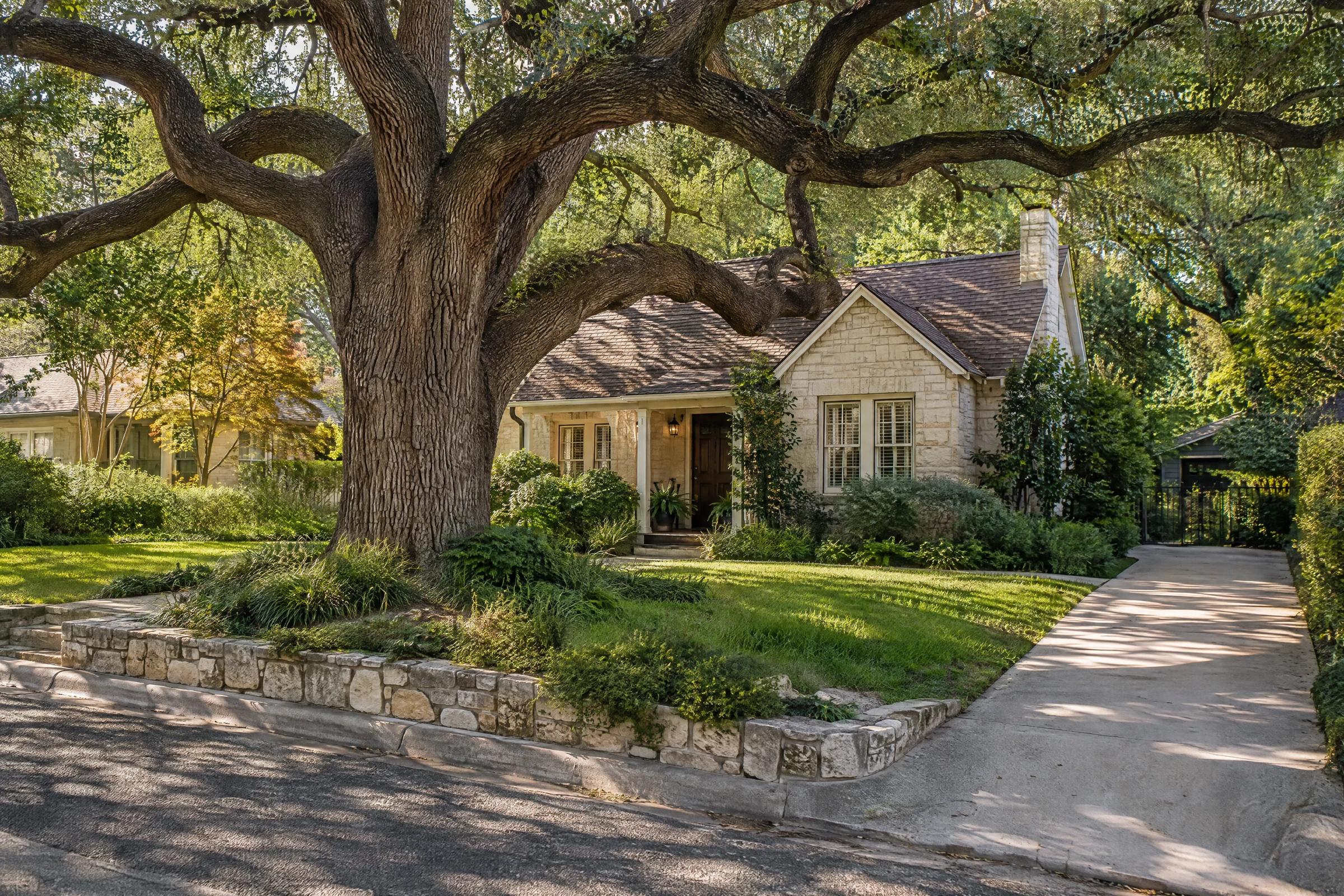
The Austin tree ordinance regulates any tree 19 inches or more in diameter on a residential lot and gives extra protection to heritage trees, listed species of 24 inches or more, according to the City of Austin's City Arborist program. Removing or heavily pruning one, or digging in its root zone, needs a Tree Ordinance Review Application, and mitigation for a removed tree is paid in replacement inches or at $200 an inch into the Urban Forest Replenishment Fund under the City's 2022 rule. Before you buy a house with an addition, pool or new driveway in mind, here is how to tell which trees on the lot are regulated, what the critical root zone does to a floor plan, and what a review costs.
By David Eimer · Austin Journal · 11 minute read · Published
The numbers
- Protected tree, residential property
- 19 inches or more in diameter, measured 4.5 feet above the groundAs of City Arborist page, retrieved September 26, 2026
Trees under 19 inches are not regulated on residential property, per the City.
Source: Austin Development Services ↗
- Heritage tree
- 24 inches or more, and a listed speciesAs of City Arborist page, retrieved September 26, 2026
Texas ash, bald cypress, American elm, cedar elm, Texas madrone, bigtooth maple, all oaks, pecan, Arizona walnut and eastern black walnut.
Source: Austin Development Services ↗
- Canopy pruning allowed without a permit
- Less than 25%As of City of Austin residential tree page, retrieved September 26, 2026
Pruning 25% or more of a regulated tree's canopy needs a Tree Ordinance Review Application.
Source: Austin Development Services ↗
- Payment rate to the Urban Forest Replenishment Fund
- $200 per inch of required mitigationAs of City of Austin rule R161-22.16, posted October 5, 2022
$75 per inch for certified affordable developments. Payment applies only where the City Arborist finds the site unsuitable for planting.
Source: City of Austin ↗
- Heritage tree variance fees
- $1,196.56 administrative, $4,997.48 commissionAs of Fee schedule effective October 1, 2025
A tree review with no building permit is $229.90, waived for dead, diseased or imminent-hazard trees.
Source: Austin Development Services ↗
- Tree canopy cover, City of Austin
- 41%As of Urban Forest Replenishment Fund presentation, September 2025
About 39,000 acres of new canopy would be needed to reach the City's 50% goal, per the same presentation.
Source: City of Austin ↗
What does the Austin tree ordinance regulate on a residential lot?
The Austin tree ordinance draws its lines by trunk diameter. On a one- or two-unit residential property in the City of Austin, “a Protected tree has a diameter of 19 inches or more, at a point measured 4.5 feet above the ground,” and “a permit is required to remove a Protected tree,” according to the City Arborist program. Trees less than 19 inches in diameter are not regulated on residential property; on commercial and multifamily land the threshold drops to 8 inches.
Measure before you assume. The City's instructions are to run a flexible tape around the trunk 4.5 feet above the ground and divide the circumference by 3.14 to get the diameter, and a multi-stem tree adds its stems: the City's own example is an 18-inch stem plus an 8-inch stem counting as a 26-inch tree. A live oak that looks modest from the street can be regulated once its two trunks are added together.
Which trees the Austin tree ordinance regulates on a residential lot
| Category | Trunk diameter at 4.5 feet | Species | What the City requires |
|---|---|---|---|
| Unregulated | Less than 19 inches | Any | Nothing on a one- or two-unit residential lot |
| Protected tree | 19 inches or more | Any | Tree Ordinance Review Application to remove, prune 25% or more of the canopy, or disturb the critical root zone; mitigation on removal |
| Heritage tree | 24 inches or more | Texas ash, bald cypress, American elm, cedar elm, Texas madrone, bigtooth maple, all oaks, pecan, Arizona walnut, eastern black walnut | Variance to remove; mitigation at 300% |
| Heritage tree, 30 inches or larger | 30 inches or more | Same list | Variance through a public process |
| Any regulated tree on commercial or multifamily land | 8 inches or more | Any | Regulated at the lower threshold |
Regulated does not mean untouchable. A regulated tree can be pruned by less than a quarter of its canopy without any application, and everyday work outside its root zone needs nothing from the City. What the ordinance controls is removal, heavy pruning and disturbance of the roots, which is exactly what an addition, a pool or a new driveway tends to do. The property research desk lists the parcel records to pull alongside the tree measurements.
Sources: Austin Development Services ↗
Which trees are heritage trees in Austin, and can they be removed?
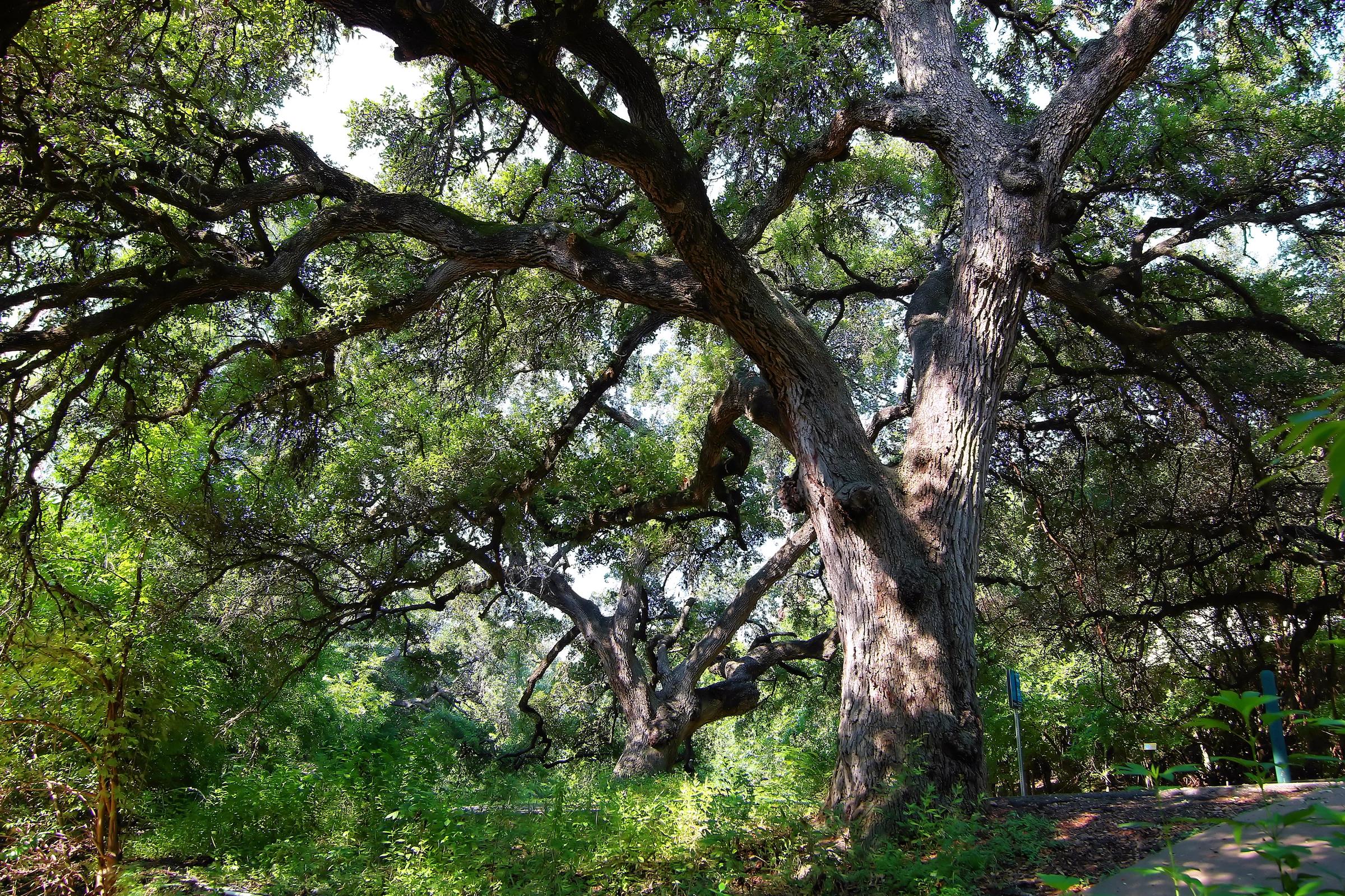
A heritage tree in Austin “has a diameter of 24 inches or more, at a point measured 4.5 feet above the ground,” and is one of ten listed species: Texas ash, bald cypress, American elm, cedar elm, Texas madrone, bigtooth maple, all oaks, pecan, Arizona walnut and eastern black walnut, per the City Arborist page. The list covers most of the big trees on central Austin lots, since live oaks, cedar elms and pecans are the common large species.
Removing a heritage tree is not a permit but a variance. The City's fee schedule prices an administrative heritage tree variance at $1,196.56 and a commission variance at $4,997.48, and the City Arborist page says that for trees 30 inches or larger “proposed variances must go through public process.” A heritage tree with a 30-inch stem in the footprint of the addition you are planning is therefore a public hearing, not a line item, and no plan should count on removing it until the City has said so.
The exceptions are about condition, not convenience. A regulated tree that is dead, diseased or an imminent hazard still needs a Tree Ordinance Review Application before removal, but the City waives the review fee for qualifying applications and, under Land Development Code 25-8-642, requires no mitigation for a tree the City Arborist finds “dead, diseased beyond rehabilitation, or constitute an imminent hazard.” The City recommends a tree report from an ISA certified arborist with that application, because “the City Arborist does not diagnose, prune, or remove trees.”
Sources: Austin Development Services ↗ · City of Austin ↗
What is the critical root zone, and why does it decide where an addition can go?
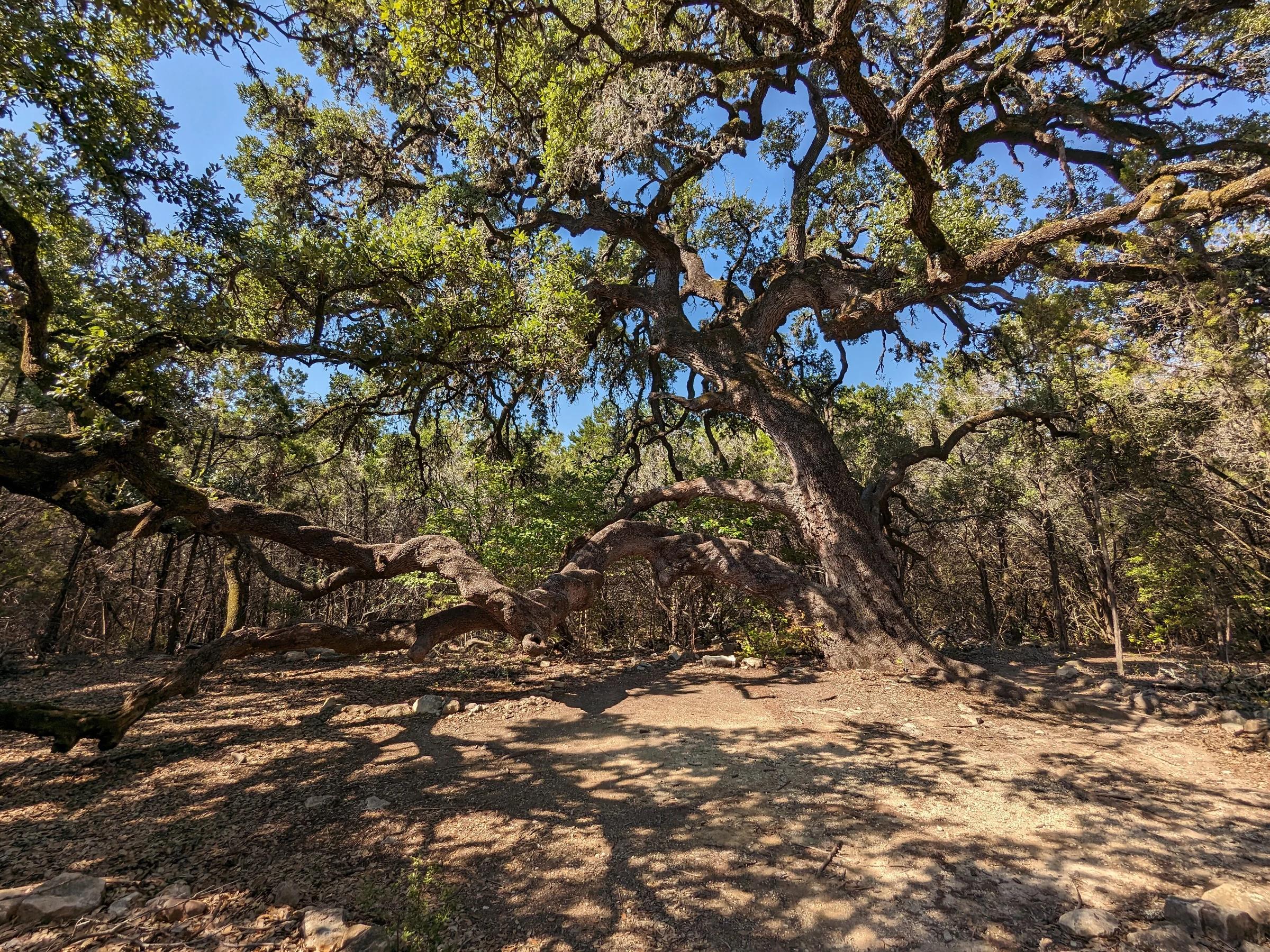
The critical root zone is the circle of ground around a regulated tree that the Austin tree ordinance protects, and it is what turns a tree at the edge of the yard into a constraint on the house. The City's residential tree page says the zone “varies with the size of its tree trunk” and that “any disturbance within the critical root zone has the potential to harm or kill a tree,” then sets three rules in rings: in the inner quarter of the zone “no impacts are allowed,” in the half zone “no cut or fill greater than 4 inches,” and across the full zone “50% of the ground within this area must be preserved without impact.”
Read those rings against a site plan. An addition's foundation, a pool's excavation, a new driveway's base and the trench for a sewer line are all cut or fill; construction access, material staging and grade changes count too. A plan that fits between trunks on a sketch can still put a slab inside a quarter zone or pave more than half of a full zone, and the review will say so. The City's rule allows a modified critical root zone in some cases, but and the City Arborist may require the applicant to demonstrate where the roots actually are; it does not relax the quarter and half zone limits.
The practical move is to measure every regulated trunk within reach of the project, including trees on the neighbor's side of the fence, and to draw the rings on the same page as the proposed footprint before the option period ends. A landscape architect or arborist can do this in an afternoon; discovering it after closing costs a redesign.
Sources: Austin Development Services ↗ · City of Austin ↗
When do you need a Tree Ordinance Review Application, and what does it cost?
A Tree Ordinance Review Application is required in Austin when a project will “remove the tree, prune 25% or more of the canopy, and/or start an activity that may impact a tree or cause a disturbance to the critical root zone,” per the City's residential tree page, and the City says the review “may take up to 10 business days.” Applications go through the Austin Build + Connect portal, the same system that holds the permit history for the house, and tree permits appear as their own layer on Property Profile.
The fees depend on whether the tree work rides along with a building permit. The Development Services fee schedule in effect since October 1, 2025 sets a tree review with no building permit at $229.90, a residential tree plan review at $515.39 when it accompanies construction, and inspections on top.
City of Austin tree review and inspection fees for residential projects
| Item | Fee |
|---|---|
| Tree review with no building permit | $229.90 |
| Tree review for a dead, diseased or imminent-hazard tree | $229.90, waived when the application qualifies |
| Tree pre-development consultation, residential | $552.44 |
| Tree plan review, residential (with a building permit) | $515.39 |
| Update fee, residential | $277.45 |
| Tree inspection, residential new construction | $569.16 |
| Tree inspection, residential all other projects | $367.84 |
| Foundation pre-pour tree inspection | $230.20 |
| Tree re-inspection | $293.65 |
| Heritage tree review variance, administrative | $1,196.56 |
| Heritage tree review variance, commission | $4,997.48 |
| Protected tree review, commission appeal | $4,997.48 |
| Residential demolition tree review | $336.14 |
Budget the review time as well as the fee. A residential building permit that touches a regulated tree collects a tree plan review, a foundation pre-pour tree inspection and a final tree inspection along the way, and each is a step that can send plans back. For a buyer, the question to answer during the option period is simply whether the project you are pricing triggers an application at all; if it does, the number that matters is not the fee but the mitigation, covered next.
Sources: Austin Development Services ↗ · City of Austin ↗
How much is tree mitigation in Austin?
Tree mitigation in Austin is measured in inches of replacement trees, and the City's Environmental Criteria Manual rule of October 2022 sets the rate by the removed tree's size and species. Mitigation “shall be calculated by multiplying the diameter of the tree removed by the percentage in the table below,” with higher rates for the shade species listed in the manual's Appendix F.
Replacement trees are measured six inches above the ground and planted on the same property unless the City approves another location, with at least 75% of the inches from species designated significant shade providers. Where the City Arborist determines a site cannot support the planting, the balance is paid into the Urban Forest Replenishment Fund “at $200 per inch of required mitigation or $75 per inch for certified affordable developments.” By our arithmetic from those rates, removing a 24-inch heritage live oak at the 300% rate would require 72 inches of replacement trees, or $14,400 if the site cannot take them; a 20-inch protected oak at 100% would require 20 inches, or $4,000.
Some trees carry no mitigation at all. The rule exempts a list of species that includes Arizona ash, chinaberry, Chinese tallow, ligustrum, mimosa, Siberian elm, tree of heaven and vitex, though a permit is still required to remove any regulated tree. The fund itself, a special revenue fund managed by the City's Urban Forester, pays for off-site planting, tree care and enforcement, per the City's September 2025 presentation on it. What the rule does not tell you is the market cost of the work: removal, stump grinding, replacement stock and irrigation are quotes to get from an arborist and a landscaper, not figures the City publishes.
Sources: City of Austin ↗
Is the tree healthy? Oak wilt and the arborist's report
A regulated tree's health is a separate question from its permit status, and in Austin the health question usually starts with oak wilt. The City's oak wilt page says any oak can be infected and that “in Austin, live oak is the most frequently infected tree,” that the disease “spreads rapidly,” and that it “will still spread through root systems even when trees are treated.” Its two rules for owners are plain: “the best time to prune oaks is July through January,” when fungal spores are least likely to infect a tree, and “always paint pruning cuts and wounds on oak trees,” because paint masks the smell of a fresh wound from the beetle that carries the spores.
For a buyer, that turns into two checks. First, ask when the oaks were last pruned and whether cuts were painted; a spring pruning without paint is a risk to note. Second, hire an ISA certified arborist for a written condition report on every regulated tree near the project, because the City will not diagnose the tree for you and its dead-and-diseased process leans on exactly that report.
Keep the two answers apart. A healthy heritage oak can still block an addition; a declining tree can still need a full application and a report before it comes down. The purchase decision needs both columns filled in, with dates, before the option period ends.
Sources: City of Austin ↗ · Austin Development Services ↗
Which Austin neighborhoods have the biggest trees?
Austin's tree canopy covered 41% of the city as of the 2022 assessment cited in the City's September 2025 Urban Forest Replenishment Fund presentation, which also put the shortfall against the City's 50% canopy goal at about 39,000 acres. Canopy is not evenly spread, and the City's Property Profile map carries a Tree Canopy 2022 layer and a tree permits layer, so the coverage on a specific lot, and any past tree permit on it, can be read for one address rather than guessed from a neighborhood name.
The older central neighborhoods in our guides are where a buyer is most likely to meet a heritage-size trunk on a small lot. The Tarrytown guide suggests reviewing a lot's slope, drainage and tree conditions with qualified help before deciding, and the Hyde Park guide points to the space between house, trees and neighboring buildings as the thing to look at closely. Neither guide ranks streets by canopy, and this post does not either; a 30-inch live oak is a lot-by-lot fact.
Sources: City of Austin ↗
What should a buyer with renovation plans do before the option period ends?
Measure first. Before the option period ends on an Austin house you plan to change, tape every large trunk within reach of the project, on both sides of the fence, and sort them into unregulated, protected and heritage using the 19-inch and 24-inch lines and the species list. Then draw the critical root zones on the same page as the proposed footprint, driveway and pool, and ask a design professional whether the plan survives the quarter-zone, half-zone and 50% rules.
If a regulated tree stands in the way, get two written answers: an ISA certified arborist's report on its condition, and, for anything heritage-sized, an opinion on whether a variance is realistic and what the mitigation inches would be. Price the project both ways, with and without the tree, and let the difference inform the offer. If the house already works, the trees are the reason to buy, and the money goes into pruning on the City's July-to-January schedule instead.
If you want the tree permits, the canopy layer and the parcel records read together for one address, bring the listing to David; he can pull the City's layers for the lot and help set up the arborist and design questions in the right order.
Sources: Austin Development Services ↗ · City of Austin ↗
Common questions
Do I need a permit to remove a tree in Austin?
On a one- or two-unit residential lot in the City of Austin, a Tree Ordinance Review Application is required to remove any tree 19 inches or more in diameter measured 4.5 feet above the ground, and the City says the review may take up to 10 business days. Trees under 19 inches are not regulated on residential property. Even a dead or hazardous regulated tree needs the application, though the review fee is waived and no mitigation is owed.
What is a heritage tree in Austin?
A heritage tree is 24 inches or more in diameter at 4.5 feet above the ground and one of ten species: Texas ash, bald cypress, American elm, cedar elm, Texas madrone, bigtooth maple, all oaks, pecan, Arizona walnut or eastern black walnut, per the City Arborist program. Removing one requires a variance, priced at $1,196.56 administratively or $4,997.48 through a commission, and a heritage tree 30 inches or larger goes through a public process.
How much does it cost to remove a heritage tree in Austin?
The City fee for a heritage tree variance is $1,196.56 if approved administratively or $4,997.48 through a commission, under the fee schedule effective October 1, 2025. Mitigation is separate: a heritage tree is mitigated at 300% of its diameter in replacement inches, which for a 24-inch tree means 72 inches of new trees or, where the City Arborist finds the site unsuitable for planting, $14,400 at the $200-per-inch fund rate, by our computation. The removal contractor's price is on top of both.
Can I trim a protected tree in Austin without a permit?
Yes, up to a point. The City of Austin allows pruning of less than 25% of a regulated tree's canopy without a Tree Ordinance Review Application; pruning 25% or more requires one. For oaks, the City's oak wilt page says the best time to prune is July through January and that all cuts and wounds should be painted immediately.
What is the critical root zone in Austin's tree rules?
The critical root zone is the protected ground around a regulated tree, sized by its trunk. The City's residential tree page sets three limits: no impacts in the inner quarter of the zone, no cut or fill greater than 4 inches in the half zone, and at least 50% of the full zone preserved without impact. Any disturbance inside the zone, per the City, has the potential to harm or kill the tree, which is why additions, pools and driveways are reviewed against it.
Take this to your next conversation
- Tape every large trunk within reach of the project, on both sides of the fence, and sort them by the 19-inch and 24-inch lines and the heritage species list.
- Draw the critical root zones on the same page as the proposed footprint, and get a design professional's read on the quarter-zone, half-zone and 50% rules.
- Get an ISA certified arborist's written condition report and, for a heritage tree in the way, a realistic view of the variance and mitigation before pricing the offer.
Sources and review date
Sources checked . Planning suggestions are editorial guidance; current property facts and requirements need an address-specific check.
- Austin Development Services: City Arborist ↗
- Austin Development Services: Trees on residential property ↗
- Austin Development Services: Dead, diseased and imminent hazard trees ↗
- Austin Development Services: Tree review and inspection fees (effective October 1, 2025) ↗
- City of Austin: Rule R161-22.16, Environmental Criteria Manual section 3 tree preservation and mitigation (October 5, 2022) ↗
- City of Austin: Urban Forest Replenishment Fund presentation (September 2025) ↗
- City of Austin: Oak wilt ↗
- City of Austin: Property Profile layers (June 2026) ↗